New publication by the Krämer lab on how the host cell factor phosphatase-2A subunit PR130 restricts replication of herpes simplex virus type-1
Jungwirth J, Jacob CF, Nguyen A, Beyer M, Mieland AO, Dejung M, Chen JX, Brenner W, Ehrhardt C, Henke A, Krämer OH (2026) The Host Cell Factor Phosphatase-2A Subunit PR130 Restricts Replication of Herpes Simplex Virus Type-1. Adv Sci (Weinh), e23697 Link
Abstract:
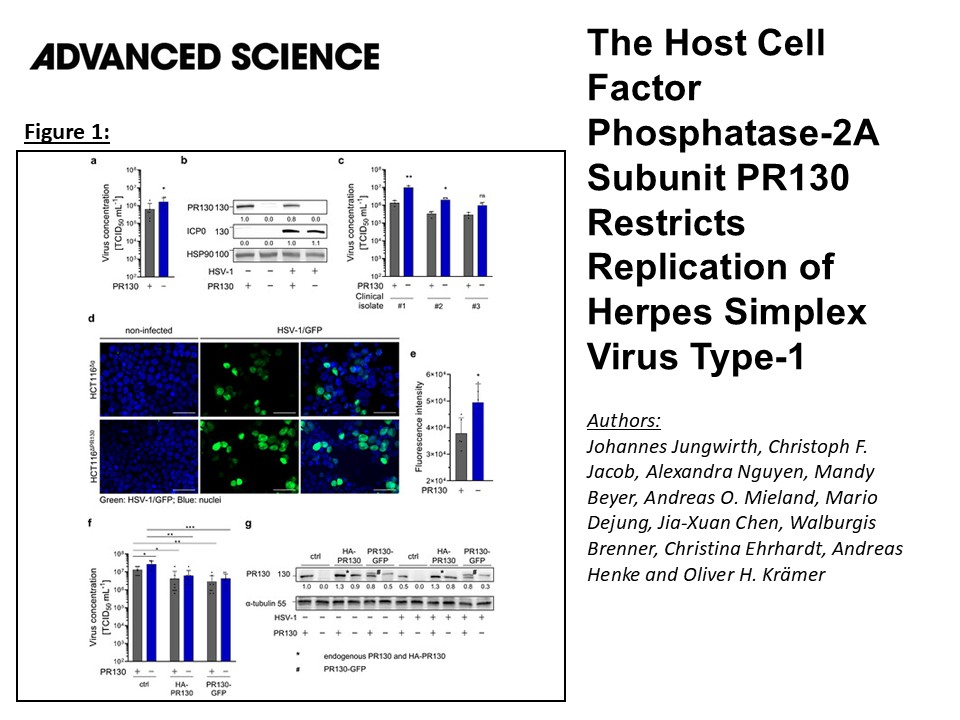
Background/Objectives: Herpes simplex virus type-1 (HSV-1) affects over 60% of the human population and increasingly develops resistance to antiviral therapies. Efficient HSV-1 replication requires host-derived deoxynucleotide triphosphates and the manipulation of cellular DNA replication and repair. This work positions the protein phosphatase 2A (PP2A) regulatory subunit PR130 (PPP2R3A) as cellular factor that suppresses the replication of laboratory strains and clinical isolates of HSV-1 in epithelial and neuronal cells. HSV-1 infection in turn decreases PR130 levels. Global proteome and phosphoproteome profiling combined with functional assays demonstrate that PR130 modulates key regulators of the cell cycle and DNA repair. PR130 controls the expression and phosphorylation of the cyclin-dependent kinase (CDK) inhibitor p21 (CDKN1A) at serine 130 (S130) which CDK2 catalyzes. The levels and activities of p21, which HSV-1 infection attenuates, and CDK2 are decisive factors for HSV-1 replication. Inhibition of the ubiquitin-specific protease USP7 stabilizes the p53-p21 axis and reduces HSV-1 viral titers. Additionally, PR130 depletion enhances signaling of the DNA damage-responsive checkpoint kinase ataxia-telangiectasia mutated (ATM) upon HSV-1 infection and creates a dependency of HSV-1 replication on ATM activity. These findings uncover host-intrinsic mechanisms regulating HSV-1 replication and highlight PR130 as central hub regulator of HSV-1 infection.
Read the full paper here: https://advanced.onlinelibrary.wiley.com/doi/10.1002/advs.202523697