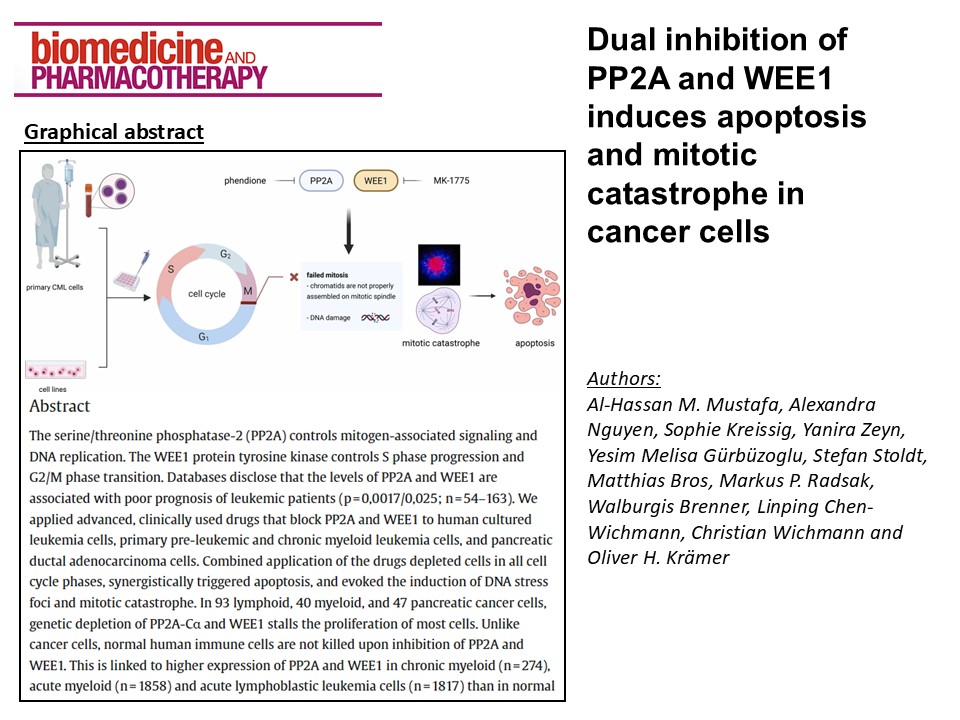
New publication by the Krämer lab on how dual inhibition of PP2A and WEE1 induces apoptosis and mitotic catastrophe in cancer cells
Mustafa AM, Nguyen A, Kreissig S, Zeyn Y, Gürbüzoglu YM, Stoldt S, Bros M, Radsak MP, Brenner W, Chen-Wichmann L, Wichmann C, Krämer OH (2026) Dual inhibition of PP2A and WEE1 induces apoptosis and mitotic catastrophe in cancer cells. Biomed Pharmacother, 199:119433 Link
Abstract:
The serine/threonine phosphatase-2 (PP2A) controls mitogen-associated signaling and DNA replication. The WEE1 protein tyrosine kinase controls S phase progression and G2/M phase transition. Databases disclose that the levels of PP2A and WEE1 are associated with poor prognosis of leukemic patients (p = 0,0017/0,025; n = 54–163). We applied advanced, clinically used drugs that block PP2A and WEE1 to human cultured leukemia cells, primary pre-leukemic and chronic myeloid leukemia cells, and pancreatic ductal adenocarcinoma cells. Combined application of the drugs depleted cells in all cell cycle phases, synergistically triggered apoptosis, and evoked the induction of DNA stress foci and mitotic catastrophe. In 93 lymphoid, 40 myeloid, and 47 pancreatic cancer cells, genetic depletion of PP2A-Cα and WEE1 stalls the proliferation of most cells. Unlike cancer cells, normal human immune cells are not killed upon inhibition of PP2A and WEE1. This is linked to higher expression of PP2A and WEE1 in chronic myeloid (n = 274), acute myeloid (n = 1858) and acute lymphoblastic leukemia cells (n = 1817) than in normal blood cells. These data suggest that pharmacological modulators of serine/threonine and tyrosine signaling allow targeted chemotherapy.
Read the full paper here: https://doi.org/10.1016/j.biopha.2026.119433