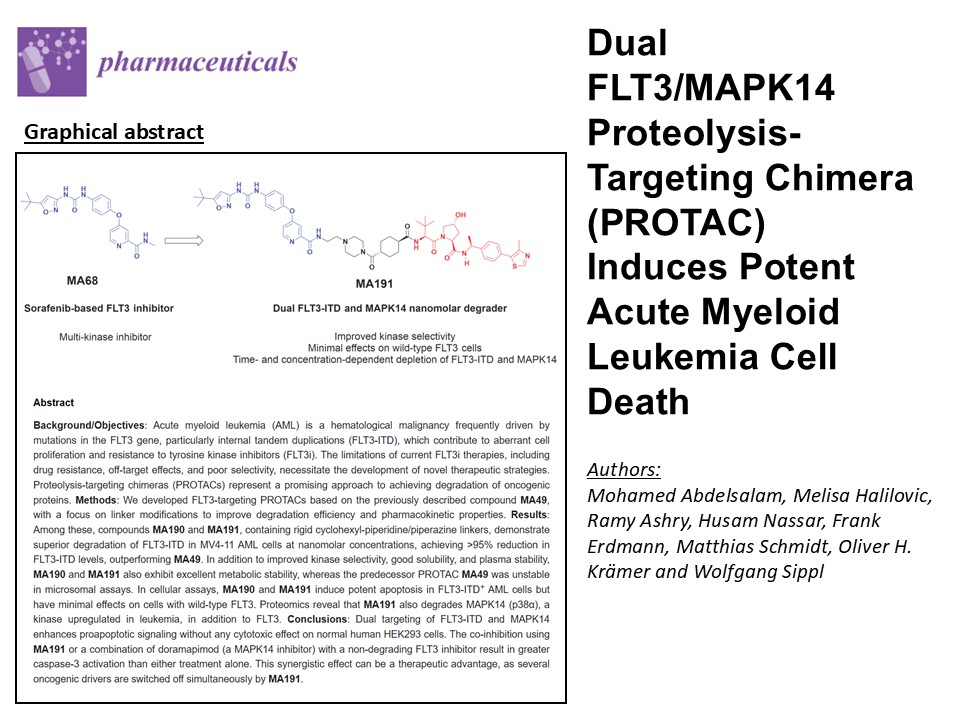
New publication by the Krämer lab on how dual FLT3/MAPK14 Proteolysis-Targeting Chimera (PROTAC) induces potent acute myeloid leukemia cell death
Abdelsalam M, Halilovic M, Ashry R, Nassar H, Erdmann F, Schmidt M, Krämer OH, Sippl W (2026) Dual FLT3/MAPK14 Proteolysis-Targeting Chimera (PROTAC) Induces Potent Acute Myeloid Leukemia Cell Death. Pharmaceuticals (Basel), 19:756 Link
Abstract:
Background/Objectives: Acute myeloid leukemia (AML) is a hematological malignancy frequently driven by mutations in the FLT3 gene, particularly internal tandem duplications (FLT3-ITD), which contribute to aberrant cell proliferation and resistance to tyrosine kinase inhibitors (FLT3i). The limitations of current FLT3i therapies, including drug resistance, off-target effects, and poor selectivity, necessitate the development of novel therapeutic strategies. Proteolysis-targeting chimeras (PROTACs) represent a promising approach to achieving degradation of oncogenic proteins. Methods: We developed FLT3-targeting PROTACs based on the previously described compound MA49, with a focus on linker modifications to improve degradation efficiency and pharmacokinetic properties. Results: Among these, compounds MA190 and MA191, containing rigid cyclohexyl-piperidine/piperazine linkers, demonstrate superior degradation of FLT3-ITD in MV4-11 AML cells at nanomolar concentrations, achieving >95% reduction in FLT3-ITD levels, outperforming MA49. In addition to improved kinase selectivity, good solubility, and plasma stability, MA190 and MA191 also exhibit excellent metabolic stability, whereas the predecessor PROTAC MA49 was unstable in microsomal assays. In cellular assays, MA190 and MA191 induce potent apoptosis in FLT3-ITD+ AML cells but have minimal effects on cells with wild-type FLT3. Proteomics reveal that MA191 also degrades MAPK14 (p38α), a kinase upregulated in leukemia, in addition to FLT3. Conclusions: Dual targeting of FLT3-ITD and MAPK14 enhances proapoptotic signaling without any cytotoxic effect on normal human HEK293 cells. The co-inhibition using MA191 or a combination of doramapimod (a MAPK14 inhibitor) with a non-degrading FLT3 inhibitor result in greater caspase-3 activation than either treatment alone. This synergistic effect can be a therapeutic advantage, as several oncogenic drivers are switched off simultaneously by MA191.
Read the full paper here: https://www.mdpi.com/1424-8247/19/5/756#