New publication by the Hofmann lab on how Th17 cells require the DNA repair sensor xeroderma pigmentosum complementation Group C to control oxidative DNA damage in a murine model
Leite JA, Bos NN, Menezes-Silva L, Martins da Silva E, Silva Leandro GD, Moreira de Goes GC, da Silva P, Oliveira S, de Almeida Santos ES, Ranfley H, Palagi I, Andrade-Silva M, Ferreira CP, Nery Neto JAO, Yuji Yariwake V, Cipelli M, Leocata B, Gonçalves T, Gabry da Silveira A, Baroni S, Weiner HL, Hofmann TG, Scheu S, Neves BJ, de Souza-Pinto NC, Colli LM, Waisman A, Marcia Muxel S, Menck CFM, Câmara NOS (2026) Th17 cells require the DNA repair sensor xeroderma pigmentosum complementation Group C to control oxidative DNA damage in a murine model. Nat Commun, 17:3157 Link
Abstract:
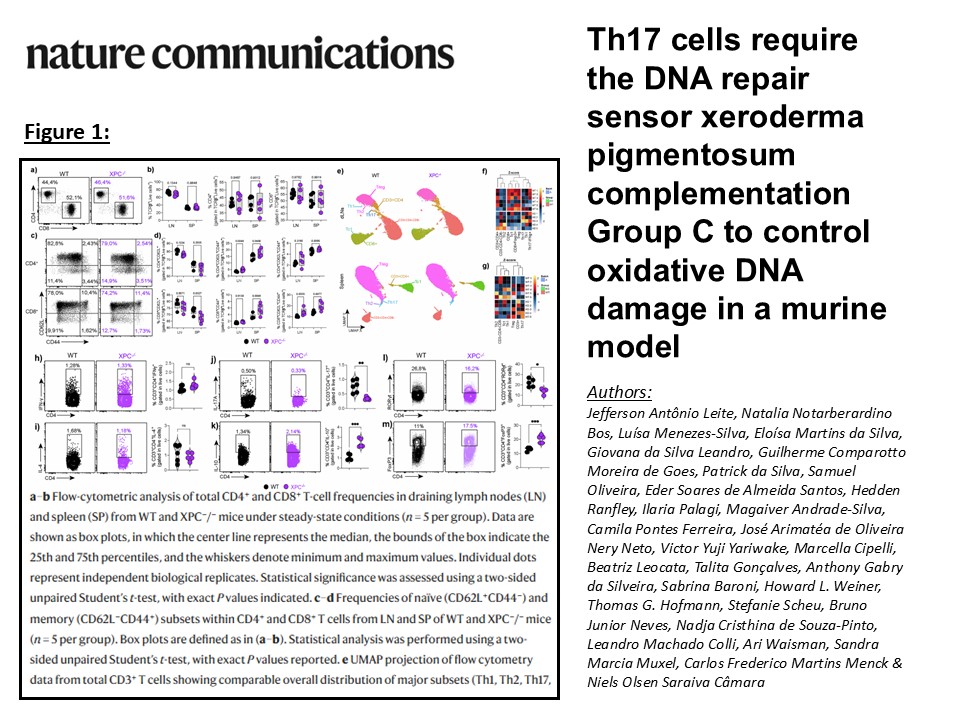
T helper 17 cells play essential roles in mucosal immunity and autoimmunity, yet the mechanisms that protect these cells from oxidative DNA damage remain poorly defined. Here we show, in a murine model, that the nucleotide excision repair sensor Xeroderma Pigmentosum Complementation Group C preserves genomic stability and metabolic fitness during T helper 17 cell differentiation. Loss of this factor reduces interleukin 17 production and increases mitochondrial reactive oxygen species and oxidative DNA damage, resulting in altered metabolic programs. Mechanistically, Xeroderma Pigmentosum Complementation Group C interacts with the base excision repair enzyme 8-oxoguanine DNA glycosylase, and its absence enhances oxidative lesion incision activity, indicating defective coordination between DNA repair pathways. Restoring antioxidant capacity rescues cytokine production and limits DNA damage in deficient cells. Together, these findings identify Xeroderma Pigmentosum Complementation Group C as a key coordinator of DNA repair and redox control required for T helper 17 cell function in inflammatory settings.
Read the full paper here: https://www.nature.com/articles/s41467-026-69914-y